Introduction
A harmonic filter is becoming essential for modern solar plants, industrial facilities, commercial buildings, and grid-connected renewable projects. As electrical networks use more inverters, drives, UPS systems, LED loads, and automation equipment, power quality becomes harder to maintain.
In simple terms, harmonics disturb the clean sine wave of voltage and current. Therefore, equipment may heat up, protection devices may trip, and energy losses may increase.
VSE Solar understands this challenge because solar power is no longer only about generating electricity. It is also about delivering clean, stable, and grid-ready power across India. The company’s public profile highlights solar EPC, AC–DC works, HT cabling, SVG installation, and grid-integration capabilities across renewable projects.
This guide explains what a harmonic filter does, why harmonic distortion matters, how different filters work, and how to choose the right solution for solar and industrial applications.
What is a Harmonic Filter
A harmonic filter is an electrical device or system that reduces unwanted harmonic currents and harmonic voltages in an electrical network. It helps restore the waveform closer to a smooth sine wave.
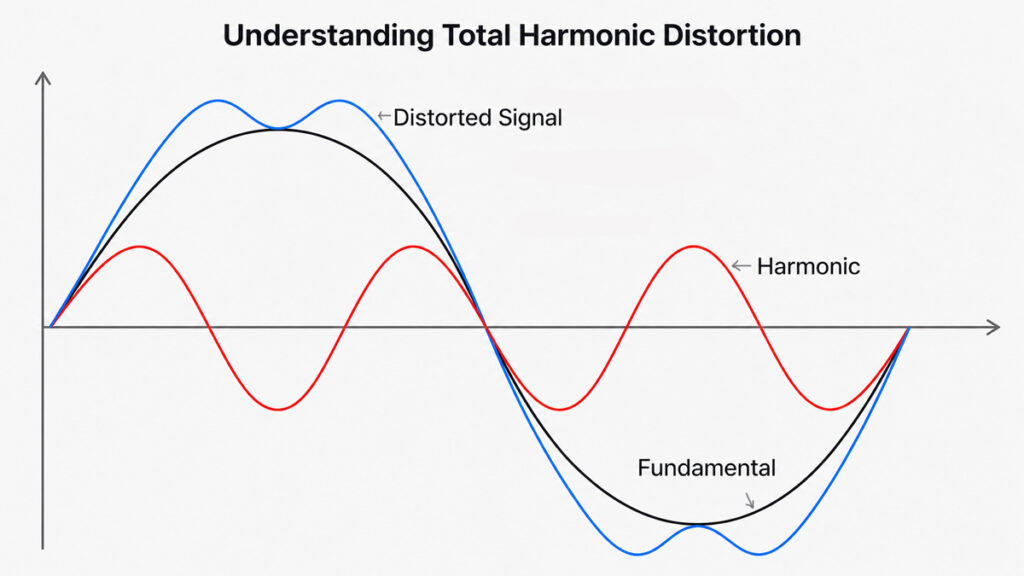
In an ideal AC power system, voltage and current follow a clean sinusoidal pattern. However, modern loads often draw current in pulses. As a result, extra frequency components appear in the system.
These extra components are called harmonics.
For example, India uses a 50 Hz fundamental frequency. A 3rd harmonic appears at 150 Hz. A 5th harmonic appears at 250 Hz. A 7th harmonic appears at 350 Hz.
A harmonic filter controls these unwanted frequencies. Therefore, it improves power quality and protects electrical assets.
In solar power plants, a harmonic filter may support inverter-based systems, transformers, switchgear, and grid interconnection equipment. It becomes especially useful when harmonic levels approach utility or internal compliance limits.
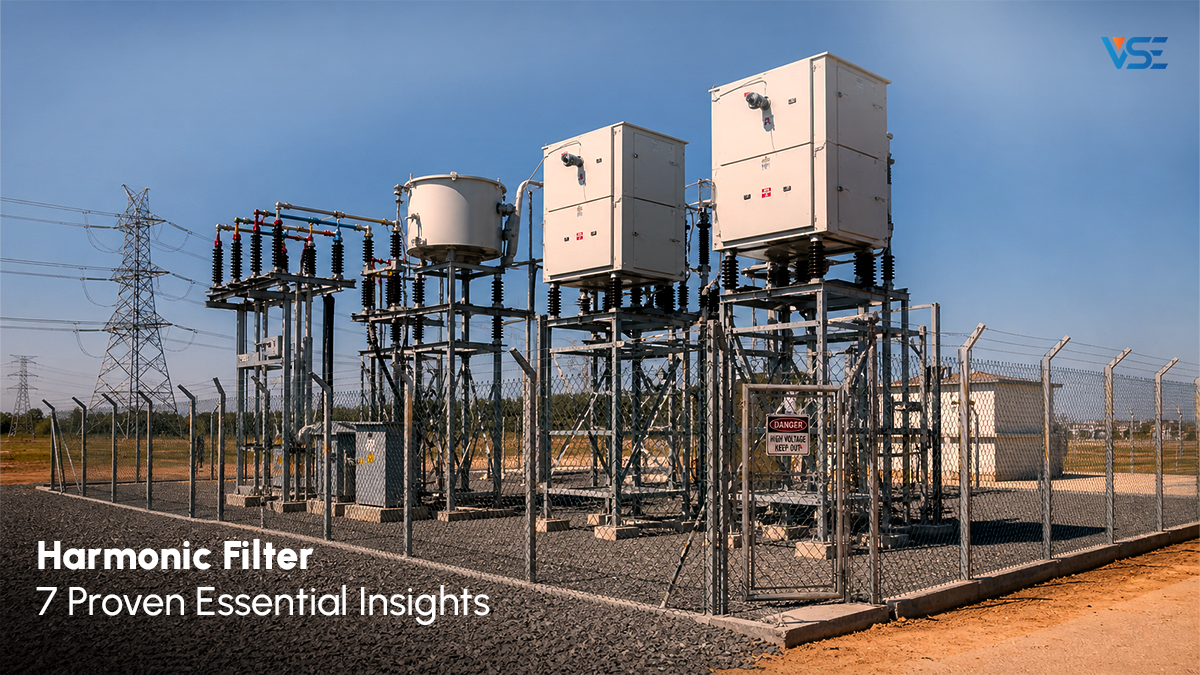
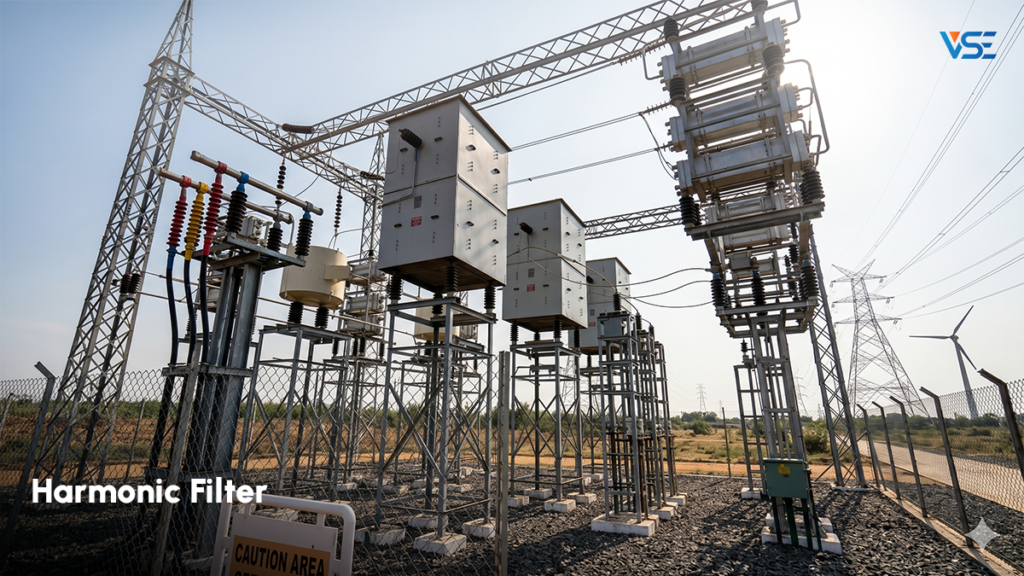
A harmonic filter may be installed near nonlinear loads, at a main distribution board, near an inverter output, or at the point of common coupling. The correct location depends on the system study.
The main goal remains simple. The filter reduces distortion before it affects the wider electrical network.
What is Harmonic Distortion
Harmonic distortion means the electrical waveform has moved away from its ideal sine wave shape. This happens when current or voltage contains additional frequencies beyond the fundamental frequency.
Harmonics are usually created by nonlinear electrical equipment. These devices do not draw current smoothly. Instead, they draw current in short pulses or switching patterns.
Common harmonic-producing equipment includes:
- Solar inverters
- Variable frequency drives
- UPS systems
- Rectifiers
- EV chargers
- LED lighting systems
- Welding machines
- Industrial automation equipment
- Battery energy storage converters
Recent power-system research notes that harmonics are unwanted frequency components in voltage and current waveforms. It also highlights that inverters, rectifiers, and other power electronic devices can increase harmonic distortion in modern networks.
Engineers often measure this issue through total harmonic distortion, or THD. THD shows how much distortion exists compared to the fundamental signal.
There are two common measurements:
- THDv: Total harmonic distortion in voltage
- THDi: Total harmonic distortion in current
Higher THD can signal higher stress on the electrical system. However, the acceptable limit depends on voltage level, system design, utility requirements, load type, and the point of measurement.
That is why a proper power quality study should come before filter selection.
Why Harmonic Filters are Important
Harmonic filters are important because poor power quality affects performance, safety, reliability, and compliance. Moreover, power quality issues often remain hidden until equipment begins to fail.
A harmonic filter helps reduce the electrical stress caused by nonlinear loads. Therefore, it can support longer equipment life and smoother operations.
Excessive harmonic distortion may cause:
- Transformer overheating
- Cable overheating
- Nuisance tripping
- Capacitor bank failure
- Protection relay malfunction
- Motor vibration
- Neutral conductor overloading
- Lower power factor
- Higher losses
- Sensitive equipment errors
- Poor grid compliance
IEEE 519-2022 is one of the most referenced standards for harmonic control. IEEE states that the standard establishes goals for systems with linear and nonlinear loads. It also describes the point of common coupling and distortion goals for electrical systems.
For solar projects and industrial plants in India, harmonic control becomes even more important because grid connectivity, utility approvals, and long-term plant performance depend on stable power quality.
The Central Electricity Authority lists grid connectivity regulations, including the 2019 amendment, under its connectivity-to-grid regulations. This makes it important for project owners to check applicable CEA, SLDC, utility, and project-specific requirements before commissioning.
A harmonic filter supports this goal by reducing inverter-related distortion and improving the quality of exported or consumed power.
Additionally, harmonic filters help teams move from reactive maintenance to preventive design. Instead of waiting for failures, engineers can design a cleaner network from the start.
Types of Harmonic Filters
Different sites need different harmonic filter solutions. The right choice depends on load profile, harmonic order, system voltage, transformer size, available fault level, power factor needs, and future expansion.
The three common types are passive harmonic filters, active harmonic filters, and hybrid harmonic filters. Electrical installation references also classify harmonic filtering into passive, active, and hybrid solutions.
Passive Harmonic Filters
A passive harmonic filter uses passive components such as inductors, capacitors, and resistors. These components create a low-impedance path for selected harmonic frequencies.
As a result, unwanted harmonic currents get diverted away from the main electrical network.
Passive filters are usually tuned for specific harmonic orders. For example, a site may need filtering for the 5th and 7th harmonics.
Passive harmonic filters are often suitable for:
- Large industrial loads
- Stable load profiles
- Fixed harmonic patterns
- Power factor correction needs
- Medium-voltage installations
- High-current applications
They can be cost-effective for predictable systems. However, they need careful design. Otherwise, resonance can occur between the filter, capacitor banks, transformer impedance, and grid impedance.
Therefore, passive filter design should always follow a harmonic study.
Passive filters may not adapt well when load conditions change quickly. For that reason, many modern facilities also evaluate active or hybrid options.
Active Harmonic Filters
An active harmonic filter uses power electronics to monitor the harmonic current in real time. Then, it injects an equal and opposite compensating current.
This cancels the unwanted harmonic current and makes the supply-side current more sinusoidal.
Schneider Electric describes active harmonic filters as systems that inject harmonic current to cancel harmonic current in the electrical distribution system. It also notes that reduced harmonic levels can improve network reliability and reduce operating costs.
Active harmonic filters are suitable for:
- Dynamic load conditions
- Commercial buildings
- Data centers
- Manufacturing plants
- Solar inverter networks
- EV charging infrastructure
- Facilities with multiple nonlinear loads
- Sites needing current harmonic correction
An active harmonic filter offers flexibility. It can adjust as the load changes. Additionally, many active filters can support load balancing and reactive power compensation.
However, active filters require correct sizing, good sensing, proper CT placement, and reliable commissioning.
For many modern solar and industrial plants, active filtering offers better adaptability than fixed passive filtering.
Hybrid Harmonic Filters
A hybrid harmonic filter combines passive and active filtering in one solution. It uses the strength of passive filters for high-capacity filtering and active filters for dynamic correction.
This approach can reduce cost while improving performance.
Hybrid harmonic filters are suitable for:
- Large industrial plants
- Renewable energy parks
- High-capacity nonlinear load systems
- Facilities with strict harmonic limits
- Sites needing power factor correction and dynamic filtering
- Systems where passive filters alone may not be enough
A hybrid filter can handle wider operating conditions. However, it needs more engineering coordination. The design must consider tuning, switching logic, load variation, transformer impedance, and grid conditions.
Therefore, hybrid solutions are usually selected after detailed simulation and field measurement.
Harmonic Filter Working Principle
The working principle of a harmonic filter depends on its type. However, the basic objective remains the same. It reduces unwanted harmonic components in the electrical network.
A passive harmonic filter works by providing a path of low impedance at selected harmonic frequencies. The harmonic current flows through the filter instead of spreading through the network.
For example, a tuned passive filter may target the 5th harmonic. When the 5th harmonic appears, the filter attracts that frequency and absorbs it.
An active harmonic filter works differently. It measures the distorted current, calculates the harmonic content, and injects a correcting current in real time. This injected current is opposite in phase to the harmonic current.
Therefore, the unwanted harmonic current gets cancelled at the source side.
A hybrid filter combines both methods. The passive section handles major harmonic components. Meanwhile, the active section adjusts for changing load conditions and remaining distortion.
A good harmonic filter system generally includes:
- Harmonic sensing
- Current transformer inputs
- Filter controller
- Power electronics or tuned passive branches
- Protection devices
- Bypass arrangement
- Thermal management
- Communication interface
- Testing and commissioning procedure
In solar plants, the working principle must also consider inverter switching behavior, plant loading, transformer configuration, cable length, and grid impedance. As a result, a harmonic filter should not be selected only by rating.
It should be selected by measurement and engineering.
A proper study identifies:
- Existing THDv and THDi
- Harmonic orders present
- Current and voltage distortion at key panels
- PCC distortion
- Transformer loading
- Capacitor bank interaction
- Resonance risk
- Filter location
- Future expansion load
This approach helps avoid under-filtering and over-filtering.
Benefits of Harmonic Filters
Harmonic filters offer technical, operational, and financial benefits. Although every site is different, most facilities install them for better reliability and lower electrical stress.
1. Improved Power Quality
A harmonic filter improves waveform quality by reducing unwanted frequency components. Consequently, voltage and current become more stable.
This helps sensitive equipment operate correctly.
2. Lower Equipment Heating
Harmonics can increase heating in transformers, cables, motors, and switchgear. Therefore, filtering can reduce thermal stress.
Lower heating may also support better equipment life.
3. Fewer Nuisance Trips
Protective devices may trip due to distorted current, overheating, or unexpected waveform behavior. A harmonic filter can reduce these events.
As a result, operations become smoother.
4. Better Transformer Performance
Transformers exposed to high harmonic currents may run hotter than expected. Therefore, filtering can reduce unwanted losses and improve reliability.
This is important in solar plants where transformers connect inverter blocks to the evacuation system.
5. Support for Grid Compliance
Many solar projects and industrial sites must meet grid code, client, or utility power quality requirements. A harmonic filter helps reduce distortion at the point of common coupling.
However, final compliance should always be verified by measurement.
6. Better Power Factor Support
Some harmonic filter systems can also support reactive power compensation. This helps improve power factor and reduce penalties where applicable.
However, harmonic correction and power factor correction are not the same thing. Engineers should design both carefully.
7. Lower Downtime Risk
Power quality problems can stop production, damage equipment, or delay commissioning. Harmonic filters reduce such risk.
Therefore, they are not only electrical accessories. They are reliability tools.
8. Improved Renewable Integration
Solar, wind, and battery systems use power electronics. These systems need cleaner integration with the grid.
A harmonic filter can support stable renewable integration when inverter harmonics or site-level distortion need correction.
Applications of Harmonic Filters
Harmonic filters are used wherever nonlinear loads create distortion. Their role changes by application, but the goal stays consistent.
They improve power quality and protect electrical equipment.
Common applications include:
Solar Power Plants
Solar PV plants use inverters to convert DC power into AC power. Since inverters use switching technology, harmonic evaluation becomes important.
A harmonic filter may be used near inverter pooling points, main LT panels, HT panels, or grid interface points.
Manufacturing Plants
Manufacturing units often use variable frequency drives, rectifiers, welding machines, cranes, compressors, and automation equipment.
These loads can create current harmonics. Therefore, harmonic filters help protect transformers, motors, and control systems.
Commercial Buildings
Large commercial buildings use UPS systems, LED lighting, elevators, HVAC drives, and IT loads. Consequently, distortion may build up across panels.
Active harmonic filters often suit these changing load profiles.
Data Centers
Data centers need stable power for servers, UPS systems, cooling systems, and backup infrastructure. Harmonic distortion can affect reliability.
Therefore, power quality monitoring and filtering are important.
EV Charging Stations
Fast chargers use power electronics. As EV adoption grows, charging stations may need harmonic mitigation.
This becomes more important when multiple chargers operate together.
Hospitals
Hospitals use sensitive diagnostic, imaging, life-support, and backup systems. Therefore, cleaner power helps improve operational reliability.
Cement, Steel, Textile, and Process Industries
Heavy industries use large drives and nonlinear electrical equipment. Harmonic filters help reduce heating, trips, and losses.
Wind and Hybrid Renewable Parks
Renewable parks combine inverter-based and converter-based generation. As a result, harmonic studies become critical for grid integration.
Harmonic Filters in Solar Power Systems: Harmonic Filter Design
Solar power systems create unique power quality challenges. The inverter is the heart of the plant, but it also changes the electrical behavior of the network.
Modern inverters are efficient and advanced. However, they still use high-speed switching. Therefore, they can contribute to inverter harmonics under certain operating conditions.
Research on renewable energy integration notes that inverter-based renewable systems can introduce complex harmonic patterns and create challenges for power quality compliance.
A harmonic filter becomes useful when distortion levels exceed acceptable limits or when a plant needs stronger power quality control.
Solar plants may face harmonic issues due to:
- Multiple inverters operating together
- Light-load operation
- Weak grid conditions
- Long cable runs
- Transformer impedance
- Capacitor banks
- Grid resonance
- Inverter control interactions
- Battery energy storage integration
- Nearby industrial loads
Because of these variables, harmonic filter selection should start with data. A power quality analyzer should record voltage, current, THD, harmonic orders, flicker, power factor, and load variation.
After that, engineers should review the point of common coupling. The PCC is important because utility-facing distortion is usually assessed at that point.
In utility-scale solar, filtering may not work alone. It may also need coordination with reactive power compensation, Static VAR Generator systems, SCADA, protection relays, and grid code requirements.
VSE Solar’s experience in solar EPC, HT electrical works, SVG installation, and grid integration gives the company a strong understanding of these field-level requirements. Its website also highlights large-scale SVG and grid-stability execution for renewable projects.
For plant owners, the key point is simple. Do not treat harmonic control as an afterthought.
Instead, include power quality review during design, commissioning, and operation.
Why Choose VSE Solar for Harmonic Filter Solutions
Choosing a harmonic filter partner is not only about buying equipment. It is about engineering, installation quality, testing, and long-term reliability.
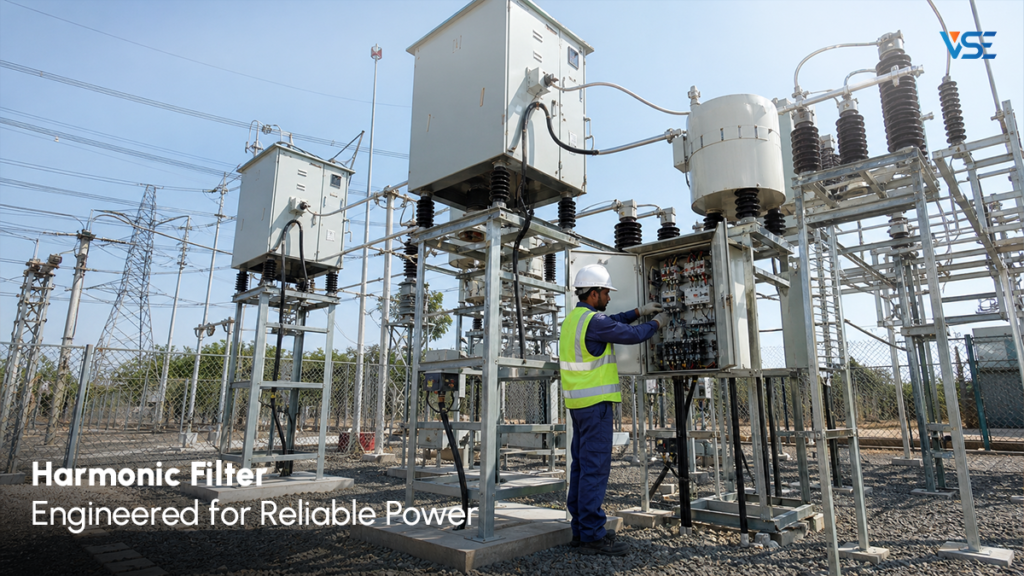
VSE Solar works as a trusted provider for renewable energy and electrical infrastructure projects across India. Its public profile describes the company as an integrated solar EPC and electrical solutions provider with over 1 GW+ renewable energy project experience.
A good harmonic filter project needs several skills:
- Electrical design understanding
- Site measurement capability
- Knowledge of solar inverter behavior
- HT and LT network understanding
- Grid compliance awareness
- Cable, panel, and protection coordination
- Testing and commissioning discipline
- O&M support
That is where execution experience matters.
As a leading harmonic filter solutions company, the right engineering partner should first study the site. Then, it should recommend a suitable solution based on load behavior, THD levels, harmonic order, transformer data, and grid requirements.
The project team should also check interaction with capacitor banks, SVG systems, APFC panels, protection relays, and inverter settings.
VSE Solar brings practical strength through its solar EPC, AC–DC works, HT cabling, SVG execution, and field installation background. Its website also highlights in-house engineering, safety-driven delivery, and compliance-focused execution.
This is important because harmonic filter performance depends heavily on correct installation. Poor CT polarity, wrong filter location, undersized cables, or weak earthing can reduce results.
An expert in harmonic filter installation will verify panel space, airflow, CT position, switching logic, harmonic spectrum, and commissioning data.
Therefore, plant owners should look beyond product datasheets. They should choose a team that understands both equipment and site conditions.
For Indian solar plants and industries, VSE Solar can position harmonic filter support as part of a wider grid-stability approach. That includes solar EPC execution, reactive power solutions, electrical integration, power quality improvement, and dependable field delivery.
How to Choose the Right Harmonic Filter
Selecting the right harmonic filter requires a structured process. A quick product selection may solve one issue but create another.
Therefore, follow these steps.
1. Conduct a Power Quality Study
First, measure the actual system. Do not depend only on assumptions.
Record:
- Voltage THD
- Current THD
- Individual harmonic orders
- Load variation
- Power factor
- Transformer loading
- Neutral current
- Voltage unbalance
- Grid conditions
A measurement period of one day may not be enough for dynamic sites. Therefore, choose a suitable recording duration.
2. Identify the Harmonic Source
Next, locate the main source of distortion. It may be a solar inverter block, VFD panel, UPS, rectifier, or external grid condition.
This step helps decide filter location.
3. Check the Point of Common Coupling
The PCC is important for grid-facing compliance. IEEE 519 uses the point of common coupling as a key reference for distortion limits and power quality goals.
Therefore, measure at both load-side and PCC points when required.
4. Choose the Filter Type
Choose passive, active, or hybrid filtering based on the study.
Use passive filters for stable and high-capacity harmonic patterns. Use active filters for dynamic loads. Use hybrid filters when both capacity and flexibility are needed.
5. Check System Voltage and Rating
The filter must match voltage, frequency, current rating, enclosure type, and fault level. Additionally, it should suit indoor or outdoor conditions.
Solar plants may need special consideration for dust, temperature, humidity, and remote monitoring.
6. Review Capacitor Bank Interaction
Capacitor banks can interact with harmonic frequencies. This may create resonance.
Therefore, engineers should check APFC panels, detuned reactors, and existing capacitors before adding a passive filter.
7. Plan for Future Expansion
A facility may add more inverters, drives, chargers, or production equipment later. Therefore, filter sizing should consider future load growth.
8. Verify Standards and Utility Requirements
Check applicable IEEE, IEC, CEA, SLDC, DISCOM, and project-specific requirements. Additionally, review client technical specifications.
9. Confirm Installation Quality
Correct installation matters. Check CT polarity, cable size, earthing, ventilation, protection coordination, bypass arrangement, and commissioning reports.
10. Monitor After Installation
Finally, measure again after installation. Confirm THD reduction and system stability.
A harmonic filter should deliver measurable results, not only theoretical compliance.
Conclusion with CTA
Harmonics are now a major power quality concern for solar plants, industries, commercial facilities, and grid-connected renewable projects. As India adds more inverter-based power, EV chargers, automation systems, and energy-efficient equipment, harmonic distortion will need more attention.
A well-designed harmonic filter can reduce distortion, protect equipment, improve reliability, and support grid compliance. However, the right solution starts with measurement, not guesswork.
For solar plants, the harmonic filter must work with inverters, transformers, HT panels, SCADA, protection systems, and utility requirements. Therefore, expert design and installation matter.
VSE Solar helps solar and electrical infrastructure projects move toward cleaner, safer, and more reliable power. For harmonic filter guidance, power quality support, or grid-stability discussion, connect with the engineering team through contact-us.